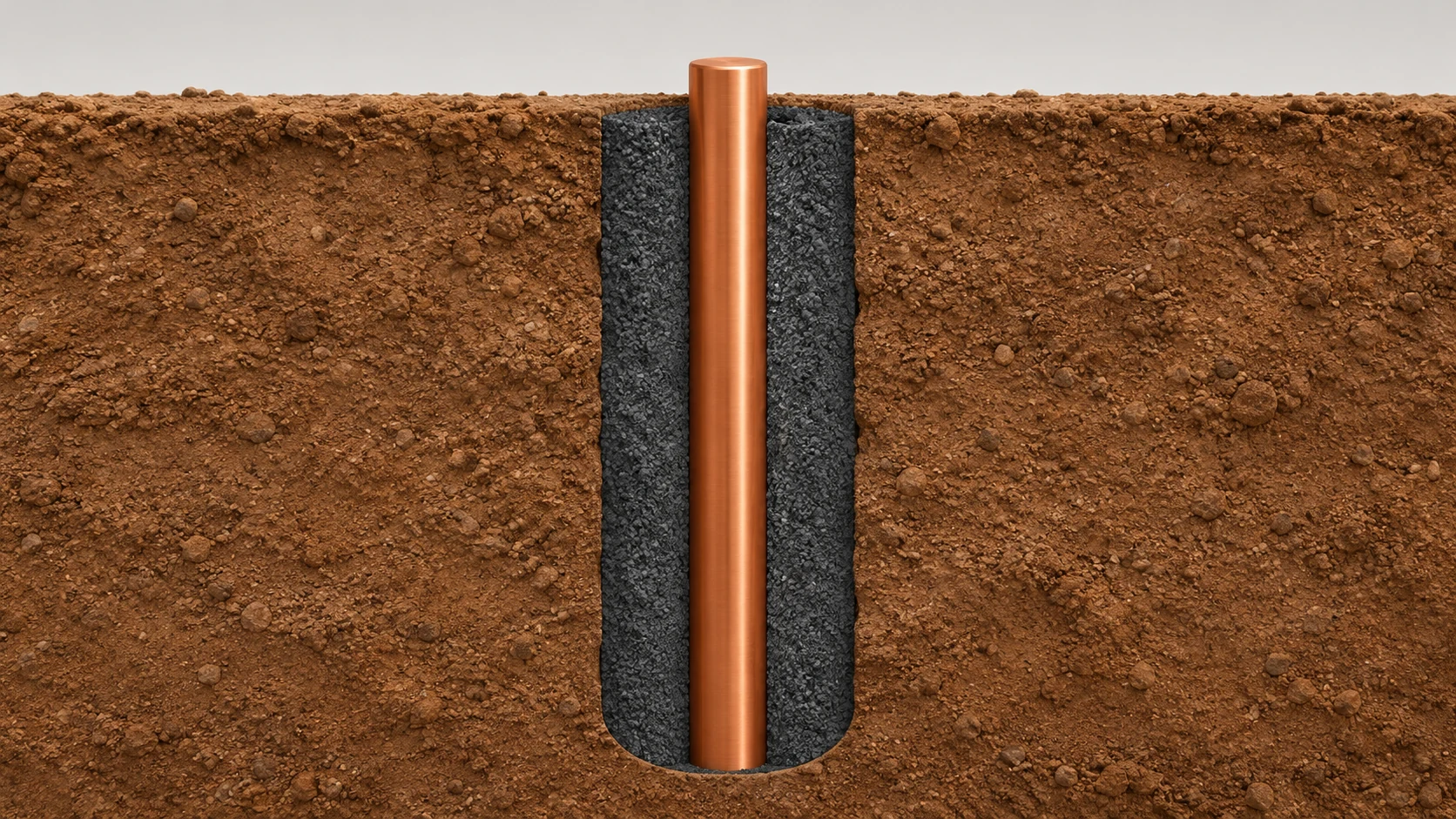
Chemical earthing describes products and arrangements that use formulated materials as part of an earth-electrode system. The label alone does not identify what a supplier will deliver. A quotation might concern an electrolytic electrode, conductive backfill, or a package containing several components. Before comparing offers, separate the metal electrode, the material around it, and the complete assembly.
That distinction gives buyers a clearer starting point: compare the same component and request its supporting documents. It does not establish that a particular arrangement will meet a site’s design requirements.
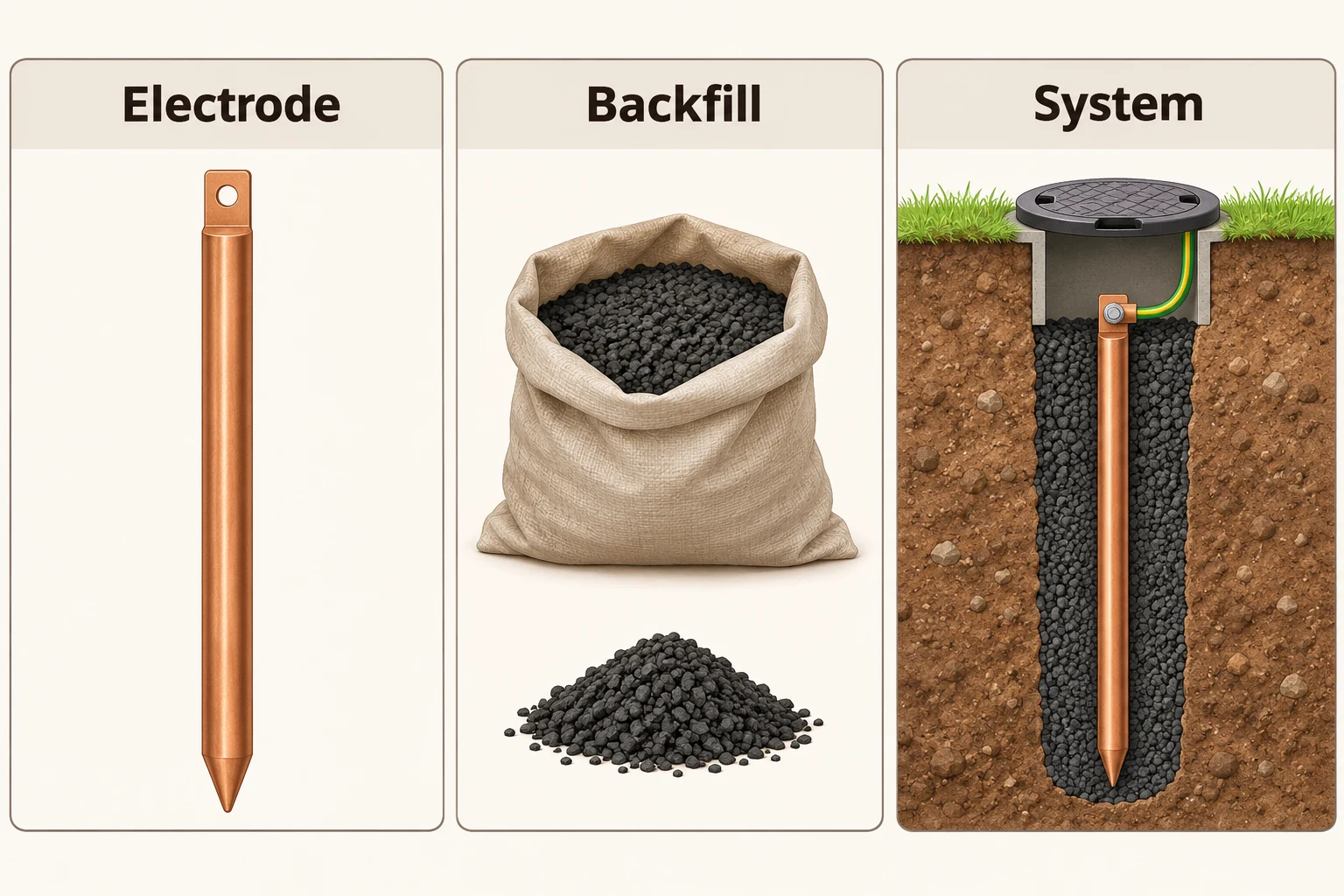
Chemical earthing: separate the electrode, backfill and system
The electrode is the conductive metal component. Some electrolytic electrodes have a hollow conductive body containing formulated salts. Harger’s technical description illustrates this construction. A solid copper-bonded steel earth rod has a different construction; surrounding it with an enhancement material does not make its internal structure equivalent to an electrolytic electrode.
Backfill is the material placed around an electrode. It has its own composition and product instructions. An electrode description therefore cannot substitute for a backfill datasheet, even when the supplier offers both in one quotation.
The system or kit is the wider assembly. For example, nVent ERICO’s handbook distinguishes chemical electrodes from packages with surrounding materials, a conductor connection and an inspection well. Package contents remain product-specific. A heading that says “complete chemical earthing” should lead to an itemized list, rather than an assumption about which accessories are included.
Read the material description before comparing claims
Conductive enhancement materials do not all have the same composition. The handbook describes GEM as carbon-based material containing cement. DEHN describes DEHNIT as a moisture-retaining special clay. These examples explain why “chemical” or “compound” is too broad a description for a technical comparison.
The useful question is which documented material the offer contains and how its stated conditions relate to the proposed application. A property described for one formulation should not be transferred to another unnamed compound. Buyers should request the actual product datasheet and the relevant handling information, rather than relying on the category name.
The same restraint applies to “maintenance-free.” Ask which component the statement covers, what conditions accompany it, and what the manufacturer’s documentation says about inspection or replenishment. A short catalogue label cannot define the obligations for an entire site.
Use a component-to-evidence enquiry worksheet
The following worksheet organizes an enquiry before engineering selection. The worksheet supports comparison; a project design requires a separate assessment. Keeping the answers beside each quoted item helps distinguish a missing document from a difference in product scope.
| Enquiry group | Information to request | What the answer helps establish |
|---|---|---|
| Product identity | Electrode construction, backfill name, product reference and an itemized package list. | Whether two quotations cover the same type of component and the same included parts. |
| Site inputs | The information the project designer needs about the location, soil conditions, available space and intended application. | Which assumptions still need assessment before the proposed arrangement can be selected. |
| Interfaces | Electrode, conductor and connection details, together with the manufacturer’s compatibility guidance for the proposed materials. | Whether the separate components have been considered together, rather than selected from unrelated descriptions. |
| Evidence and upkeep | The applicable product documents, the scope of any performance statement, and documented inspection or maintenance conditions. | What the supplier’s claim actually covers and which continuing responsibilities remain to be clarified. |
When an answer is incomplete, record the specific gap. For example, “backfill product not identified” gives a supplier a clear question to resolve. “Chemical earthing required” leaves the central ambiguity in place. Keep the product reference attached to every document so that a datasheet for one material is not used to support a different quotation.
Where a supplier offers an alternative, ask for the same information again. Comparing component lists and documented conditions provides a more useful discussion than comparing broad labels alone.
A similar appearance does not establish interchangeability
A copper-coloured electrode in a drawing tells a buyer little about its internal construction or the material surrounding it. Likewise, a photograph of a bag does not identify the formulation. Product names, construction details and the manufacturer’s documents provide the necessary distinctions.
An ordinary earth rod, an electrolytic electrode and a backfill product should therefore remain separate entries in a comparison. A proposed substitution needs its own supporting information and project review. The presence of an enhancement material alone does not demonstrate that the assembled arrangement satisfies the project’s requirements.
Keep any quoted resistance or service-life statement attached to its stated conditions and source. This article provides no universal resistance target or installation recipe. Those decisions require the relevant project inputs and the responsible designer’s assessment. A clear procurement enquiry helps collect that information; it does not replace the assessment.
Identify the rod when that is the component being sourced
YOJIU’s copper-bonded earth rod page describes copper-bonded steel rods with dimensional and threaded configurations. That provides a starting point for identifying a conventional rod. It does not establish an electrolytic-electrode construction or the supply of a chemical backfill.
For a rod enquiry, include the product reference and required connection details. For a complete chemical-earthing proposal, keep the electrode, surrounding material and assembly requirements separately identified so each supplier can answer against the same scope.