


Neutral to earth voltage is the potential difference between the point identified as neutral and the earth reference identified in a measurement record. In the low-voltage AC examples discussed here, a reading may involve neutral-path voltage drop, the actual system arrangement or the instrument’s response. The number alone does not establish which explanation applies.
The useful task is to separate those possibilities before drawing a conclusion. A record should identify its reference points, location, load conditions and instrument context. The terms N–E and neutral-to-ground, or N–G, should be read with those definitions attached.
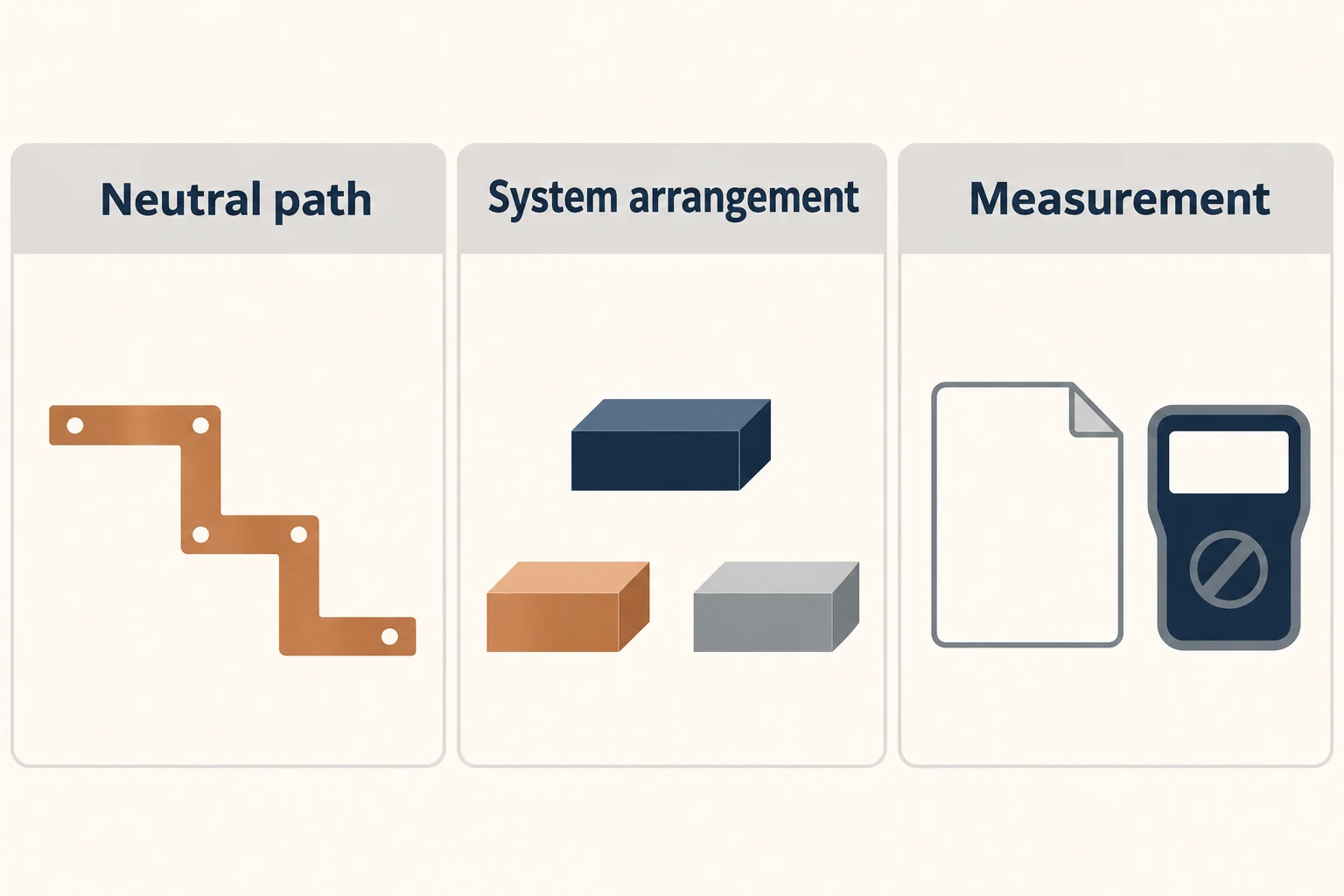
Neutral to earth voltage can reflect neutral-path drop
Current flowing through the neutral path’s resistance or impedance produces a voltage drop. Under the reference arrangement described in the cited manufacturer examples, that drop can appear as a neutral-to-ground potential difference at the load location.
AMETEK’s white paper explains the basic relationship between neutral current, wire resistance and the resulting voltage. The explanation supports considering the load and neutral path together. It does not establish that a particular reading at an unidentified installation has the same cause.
Other conditions being comparable, a change associated with the recorded load state can be relevant to that explanation. It still needs the actual circuit information. A single snapshot cannot establish whether the path, loading and reference arrangement correspond to the example, or whether another condition is involved.
Keep a possible physical explanation separate from an assessment of the installation. A plausible voltage-drop mechanism does not turn an unexplained record into proof of normal operation.
The system arrangement defines what the references mean
Neutral and earth labels do not supply a complete description of the installation. The location and the actual reference arrangement matter when interpreting their potential difference. A diagram from another country or another supply arrangement cannot fill those gaps automatically.
Fluke’s receptacle application note makes assumptions about the neutral and ground paths in its examples and also discusses misidentified or incorrectly connected references. The useful lesson for a report reader is to retain the arrangement and reference information. The note’s outlet details and numerical examples should not be treated as a universal description of every installation.
Where a report uses only an abbreviation, ask for the point or asset it identifies. Do not assume that two records labeled “earth” used the same physical reference. Resolving that ambiguity is part of understanding the observation, before any project-specific conclusion is considered.
Instrument response can change the interpretation
Capacitive coupling can produce a displayed voltage on a floating conductor near energized wiring. A high-impedance instrument can display that coupled voltage. Fluke’s dual-impedance explanation describes this mechanism and the influence of the instrument’s input characteristics.
This is a conditional explanation, not a label to apply to every unexpected N–E reading. The conductor and reference conditions must support the interpretation. An unexplained voltage should not be dismissed as “ghost voltage” merely because that possibility exists.
For an existing record, retain the instrument model, the recorded measurement mode and any relevant method notes. If readings from different instruments appear inconsistent, identify the method difference rather than choosing the more convenient number. The responsible electrical professional can assess that information against the actual installation and appropriate equipment documentation.
Give the assessor a record with its context
A concise technical handoff should preserve the observation and identify what remains unknown. Include the following information already available in the report:
- Reference and location: the neutral point, earth reference and asset or location concerned.
- Operating context: the recorded load state and time, including relevant differences between observations.
- Instrument context: the model, recorded mode, method notes, units and any display qualifiers.
- Unresolved information: missing arrangement details, conflicting records or assumptions that have not been confirmed.
This organizes information for assessment; it does not prescribe energized measurements or a wiring change. A single reading is insufficient to assign a universal acceptable value, identify a unique fault or authorize a modification to neutral and earth connections.
An electrode enquiry is a separate question
A voltage record is not an earth-electrode resistance test record. YOJIU’s copper-bonded earth rod page identifies an electrode component. It does not establish a remedy for a neutral-to-earth voltage observation.
Keep any electrode enquiry tied to the project’s earthing design and component requirements. Return the voltage record, with its missing context identified, to the responsible electrical professional before treating an accessory or system change as the answer.