
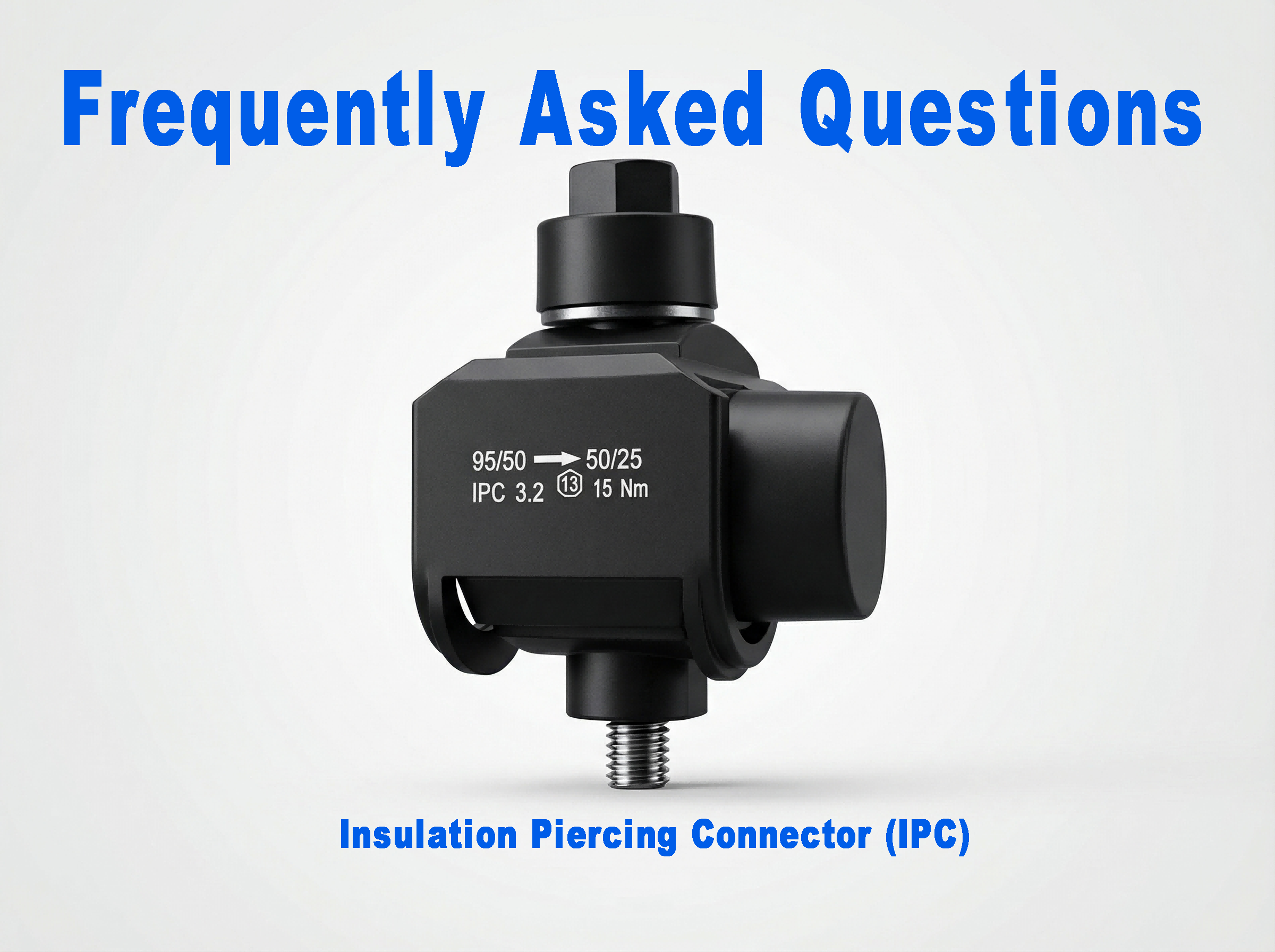
Insulation Piercing Connectors (IPC) are widely used in low-voltage power distribution, aerial insulated cables, outdoor lines, municipal street lighting, building wiring and other systems. Featuring no insulation stripping required, fast installation, insulated sealing and reliable operation, YOJIU has compiled these professional FAQs for engineering selection, standardized installation and safe use, based on product standards and field applications.
1
Product Basics & Selection Criteria
1. What is an Insulation Piercing Connector (IPC)?
An IPC achieves reliable electrical connection between main and branch cables through high-strength alloy piercing blades that penetrate cable insulation directly. Installation requires no stripping, crimping or welding. The sealed, insulated enclosure ensures waterproofing, dustproofing and leakage protection. It is suitable for low-voltage power distribution systems up to 1kV AC / 600V DC.
2. Does IPC support connections between copper and aluminum cables?
Yes. Standard models are compatible with both copper and aluminum insulated conductors. For direct copper-to-aluminum transitions, bimetallic contact IPCs are recommended to effectively resist galvanic corrosion and ensure long-term stability.
3. What are the voltage and current ratings of IPCs?
Standard low-voltage series: 1kV AC / 600V DC
High-power and PV-specific series: up to 1500V DC, with rated current ranging from 350A to 550A.
Selection must strictly match system voltage, load current and cable cross-section range.
High-power and PV-specific series: up to 1500V DC, with rated current ranging from 350A to 550A.
Selection must strictly match system voltage, load current and cable cross-section range.
4. Can IPCs be removed and reused after installation?
No. IPCs are one-time compression connectors. Disassembly may deform piercing blades and damage sealing structures, leading to risks such as poor contact, abnormal heating and insulation failure. Reuse is strictly prohibited.
5. Are IPCs suitable for connecting bare conductors?
No. IPCs are designed exclusively for insulated cables. Bare conductors cannot form a proper seal, leading to water ingress, oxidation, short circuits and major safety hazards.
2
Installation & Technical Requirements
6. Do I need to strip cable insulation before installing an IPC?
No. Stripping insulation damages the product design, increases contact resistance and reduces sealing performance. Proper installation allows piercing blades to penetrate insulation and connect conductors automatically.
7. What should I do if the torque nut does not shear off during installation?
Stop installation immediately. Common causes include uncalibrated torque tools, improper operation or defective product. Do not over-tighten forcefully. Replace the connector and reinstall using a calibrated torque wrench.
8. Can IPCs be installed under live (energized) conditions?
Yes (for low-voltage systems). The fully enclosed insulated design and no-stripping installation reduce electric shock risk. However, all national and industrial live-working safety regulations must be strictly followed with proper personal protective equipment.
9. What special tools are required for IPC installation?
Only a calibrated torque wrench is needed. No wire strippers, crimpers or welding equipment are required, enabling simple, efficient and consistent installation.
10. How to confirm proper and effective IPC installation?
- Main and branch cables are correctly placed and aligned in designated compartments;
- Torque nut is tightened evenly until it shears off at the rated torque;
- Sealing gaskets are fully compressed, with the housing tightly fitted, no warping or gaps.
3
Electrical Performance & Environmental Resistance
11. Will IPCs cause high contact resistance or excessive heating during operation?
With proper selection and standard installation, qualified products feature low and stable contact resistance (typically lower than that of the cable itself). The torque mechanism ensures constant blade pressure, and temperature rise under normal load complies with standards without abnormal heating.
12. Are there any energized parts on the outer housing of the IPC?
No. The product uses a fully insulated and sealed design. All external metal components are insulated, so there is no electric shock risk under normal operating conditions.
13. What ingress protection (IP) rating do YOJIU IPCs achieve?
YOJIU Insulation Piercing Connectors reach IP65–IP68, providing excellent waterproof and dustproof performance for outdoor, humid, buried and ducted environments.
14. Can IPCs withstand harsh outdoor operating conditions over the long term?
Yes. The enclosure is made of UV-resistant, flame-retardant, high-performance engineering plastic, and piercing blades are tinned for corrosion protection. They can withstand extreme temperatures, salt spray, acid rain, UV radiation and other outdoor conditions.
4
Troubleshooting & Quality Inspection
15. What are the main causes of overheating or burnout in IPCs?
- Incorrect product selection: mismatched cable size, current or voltage rating;
- Non-standard installation: torque nut not sheared, cables misaligned;
- Substandard product quality: inferior blade material, failed sealing structure;
- Long-term overloading of the circuit.
16. How to inspect the quality of an IPC connection?
- Electrical test: Measure contact resistance with a micro-ohmmeter; typical acceptable value is < 5mΩ.
- Temperature test: Check operating temperature with an infrared thermal imager; no significant difference compared to other points in the same circuit indicates normal performance.
17. Do I need to apply insulating tape after IPC installation?
No. The product structure already provides sufficient insulation, sealing and waterproofing. Additional taping provides no safety improvement and may hinder heat dissipation and later inspection.
5
Application & Scope of Use
18. Can IPCs be used for parallel splicing of cables?
IPCs are mainly designed for main-to-branch T-tap connections. They may be used for small-current, non-stressed parallel splices only after confirming technical parameters, but are not recommended as the primary parallel splicing method.
19. Are IPCs suitable for Aerial Bundled Cables (ABC)?
Yes. IPCs are a standard solution for overhead insulated distribution lines, outdoor T-taps and street lighting branch connections.
20. Can IPCs be used in medium-voltage systems of 10kV and above?
Standard low-voltage IPCs are not suitable. Medium-voltage systems must use special medium-voltage IPCs in strict accordance with manufacturer specifications and power grid standards.
Compiled and issued by the Technical Center of YOJIU
For more product information and technical support, please visit our official website: www.yojiu.com
Post time: Mar-20-2026